


Incremental peritoneal dialysis (PD) helps patients ease into dialysis – alleviating symptoms and preserving redisual kidney function longer1
Incremental PD is an optimal start to daily dialysis for clinically appropriate patients who have both residual kidney function (RKF) and chronic kidney disease (CKD) symptoms.
In addition to giving patients the confidence to continue living their best lives with progressive kidney disease, incremental PD helps reduce symptoms, promotes timely placement of a PD catheter, and allows patients to build dialysis into their daily routine.
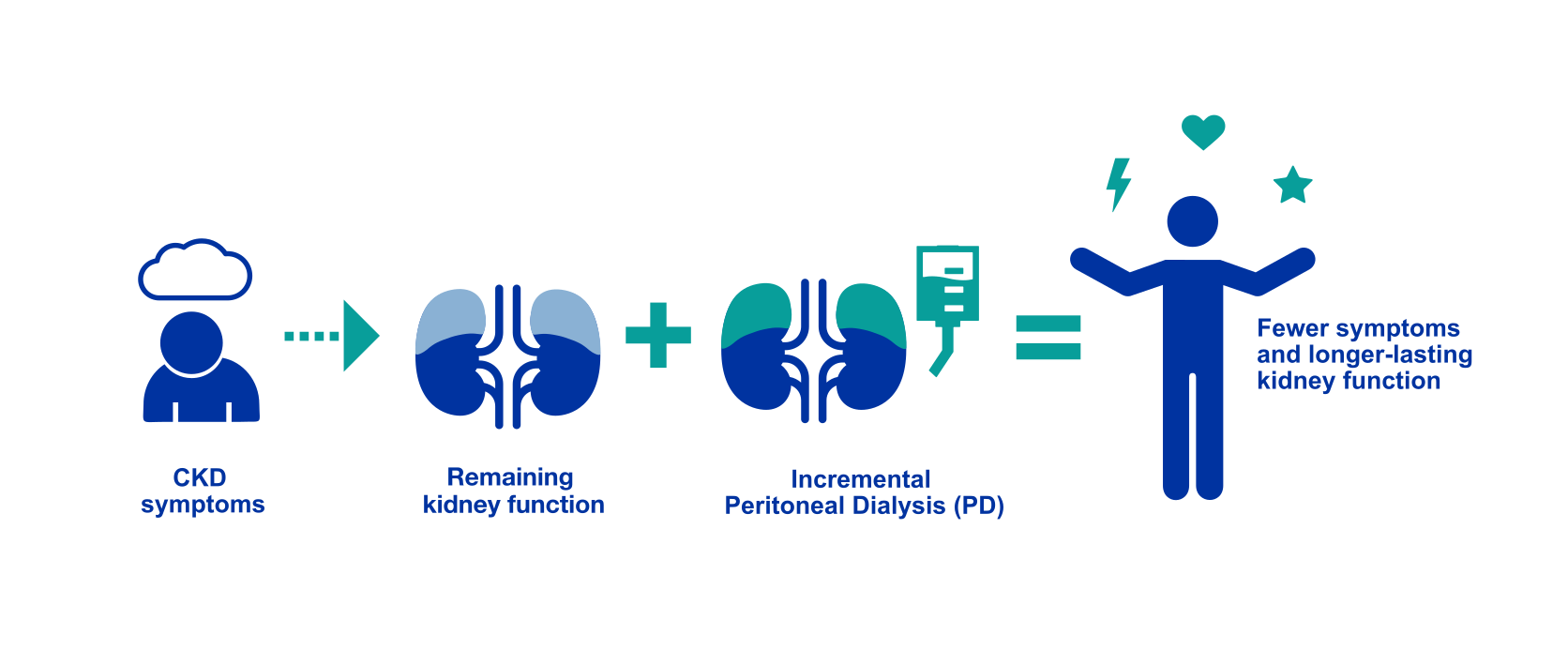
Benefits of incremental PD
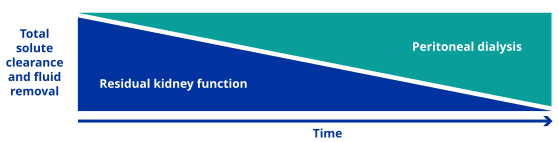
An incremental start to PD may offer:
- As little as one treatment per day, and/or less volume
- Fewer supplies to manage and store
- Longer viability for PD, reducing disruption in care
Patients who may benefit from incremental PD exhibit:
- RKF — about 500 ml of urine per day
- GFR less than or equal to 20
- CKD symptoms that interfere with daily life — such as fatigue, swelling, shortness of breath, and trouble completing everyday tasks

Incremental PD reduces stress on the remaining nephrons, helping to retain natural kidney function longer1
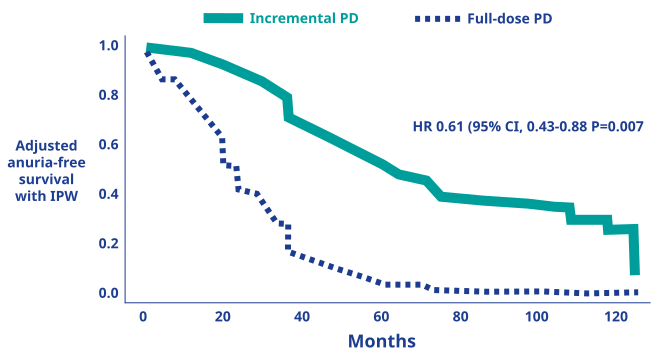

- Increased sodium and water removal2
- Better clearance of middle molecular weight toxins2
- Superior phosphorus clearance2
- Endogenous production of erythropoietin2
- Better global and cardiovascular mortality2
Starting incremental PD may relieve patients' symptoms earlier, helping them feel better

- More energy4
- Less mental fog5
- Better blood pressure control4

- RKF for longer1
- Preservation of peritoneal membrane2
- Reduced absorption of glucose6
- Fewer infections4

- Less lower back pain4
- Easier breathing
- Increased appetite4
- Less feeling of fullness5


Incremental PD may give patients more confidence in managing their care7
- A planned start gives patients agency in their treatment options and their start to dialysis8
- Incremental treatment provides patients with time to adjust to dialysis physically and emotionally
- A gentler start may help patients gain confidence in adapting to treatment and allow time to build a support network
Incremental PD is done at home and offers an optimal start to dialysis for clinically appropriate patients.

Talk to your eligible patients about starting incremental PD
Easing patients into dialysis can help them achieve better clinical outcomes while maintaining quality of life.

References:
1. Lee Y, Chung SW, Park S, Ryu H, Lee H, Kim DK, Joo KW, Ahn C, Lee J, Oh KH. Incremental Peritoneal Dialysis May be Beneficial for Preserving Residual Renal Function Compared to Full-dose Peritoneal Dialysis. Sci Rep. 2019 Jul 12;9(1):10105. doi: 10.1038/s41598-019-46654-2. PMID: 31300708; PMCID: PMC6626037. 2. Incremental Peritoneal Dialysis: A Tailored Approach to Renal Replacement Therapy Anjali Bhatt Saxena, MD FASN Clinical Professor of Medicine, Stanford. 3. Bricker NS, Morrin PA, Kime SW., Jr. The pathologic physiology of chronic Bright's disease. An exposition of the 'intact nephron hypothesis'. Am J Med. 1960;28:77-98. doi: 10.1016/0002-9343(60)90225-4. 4. Alrowiyti IM, Bargman J. A Review of Residual Kidney Function in Peritoneal Dialysis Patients. Indian J Nephrol. 2023 Jul-Aug;33(4):239-246. doi: 10.4103/ijn.ijn_242_23. Epub 2023 Aug 16. PMID: 37781547; PMCID: PMC10503572. 5. Brown EA, Blake PG, Boudville N, Davies S, de Arteaga J, Dong J, Finkelstein F, Foo M, Hurst H, Johnson DW, Johnson M, Liew A, Moraes T, Perl J, Shroff R, Teitelbaum I, Wang AY, Warady B. International Society for Peritoneal Dialysis practice recommendations: Prescribing high-quality goal-directed peritoneal dialysis. Perit Dial Int. 2020 May;40(3):244-253. doi: 10.1177/0896860819895364. Epub 2020 Jan 21. PMID: 32063219. 6. Cheetham MS, Cho Y, Krishnasamy R, Jain AK, Boudville N, Johnson DW, Huang LL. Incremental Versus Standard (Full-Dose) Peritoneal Dialysis. Kidney Int Rep. 2021 Dec 1;7(2):165-176. doi: 10.1016/j.ekir.2021.11.019. PMID: 35155856; PMCID: PMC8820986. 7. Bodenheimer T, Lorig K, Holman H, Grumbach K. Patient self-management of chronic disease in primary care. JAMA. 2002 Nov 20;288(19):2469-75. doi: 10.1001/jama.288.19.2469. PMID: 12435261. 8. Henry SL, Munoz-Plaza C, Garcia Delgadillo J, et al. Patient perspectives on the optimal start of renal replacement therapy. J Ren Care 2017 Sep;43(3):143-55. doi:10.1111/jorc.12202.