

Kidney Failure Is No Match for This Family
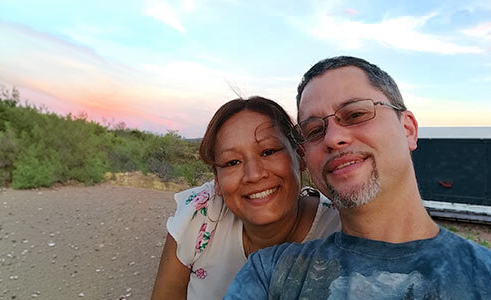
Teresa Rodriguez was relieved, at least for the moment. It was August 2018 and the results of her mammography showed that a lump in her right breast had disappeared completely, casting aside fears of cancer. Just to be safe, however, her doctors did a full set of labs.
When the phone rang the next day, it was her primary care physician calling to say she should get to the emergency room — as fast as possible. Her kidney function was almost nonexistent; down to five percent.
“The ER doctor said, ‘I don’t understand how you’re standing here acting completely normal. You literally should be on your death bed right now,’” Teresa recalls. “Then he paused and said, ‘Do you realize what I’m telling you?’”
It was difficult for Teresa to grasp how serious her situation was, given that she didn’t feel sick and there wasn’t (and still isn’t) a clear explanation for her kidney failure. But there was another reason she wasn’t as overwhelmed as one might expect.
For Teresa and her family, this wouldn’t be the first time a medical evaluation would alter their way of living. Several years prior, at age six, Teresa’s younger son Trevor was diagnosed with adrenoleukodystrophy — a rare, often fatal, disease that causes severe mental and physical disabilities that get progressively worse with time.
Trevor beat the odds and is now 18 years old. Though completely reliant on others for his day-to-day needs, he can still hear and understand conversations, and enjoys when his family “talks smack” and tells stories from his past. He has an especially tight bond with his big brother, Kevin Jr., who trained to be a certified caregiver in order to provide for Trevor as both a professional and a loving sibling.
Learning the Ropes—Home Dialysis Therapy
That caring instinct apparently runs in the family. About a month after Teresa’s kidneys failed and she decided to try home hemodialysis (HHD), her husband, Kevin Sr., was right there by her side to learn all the steps required to be her care partner.
“Because I’m so independent he’s mostly just here watching me,” she says with a laugh. “But he still helps me snap and tap (a method of jiggling and tapping the lines on a dialysis machine to clear the air out at the start of a treatment) because that's his job. He's here to support me. Because of Trevor, we're so used to doing stuff like this. Learning HHD wasn't really a big shocker for either of us.”
Just as they all adjusted to Trevor’s healthcare needs, the family has stepped up to “take care of mom” and make sure she has everything required for success. For her part, Teresa says she loves how she feels on HHD, and that the independence of doing therapy at home — on her own dialysis machine schedule — made it easier to accept having dialysis machine kidney disease.
“I think I got instant gratification from HHD,” she says. “Right away I was like, ‘What? I can have my whole day and run therapy whenever I want? I have plans tonight and can run this morning instead?!'”
Setting up Camp—Traveling on Dialysis
Another reason HHD agrees with Teresa is that it allows her to travel. She is even able to bring her dialysis machine with her when the family goes camping.
“We LOVE camping — that’s our vacation!” says Teresa enthusiastically. “And we like to tent camp. Yeah, an RV would be a luxury, but we love to set up the tent and set up the site. We just love the outdoors.”
When asked how her family of four—with all their health needs and machines—can take on such a challenge, she explains that they own a very large 3-room tent and a “generator that’s enough to light up a whole house.” One room of the tent is designated solely for dialysis and the rest is large enough for their other activities and necessities.
Teresa says her care team at Fresenius Kidney Care Westgate Home in Glendale, Arizona has helped her learn the ins and outs of traveling with dialysis equipment and finding a therapy schedule that works for her and her lifestyle—wherever and whenever she needs to dialyze.
“They’re my homies,” says Teresa of her care team. “They cater to your needs. They’re just so open minded with me. They just listen.”
Journey to a Kidney Transplant
Soon, Teresa and her care team set their sights on one goal—a kidney transplant. As it turned out, Teresa's path to transplant had a few unexpected turns. First came surgery to repair her tricuspid valve (a valve in the heart that controls blood flow). Then more testing after doctors found a liver condition. “It felt like I was almost never on the (transplant waiting) list,” Teresa says with a laugh. “Every time we figured one thing out, there was something else.”
When Teresa received a letter saying she would not be put on the list, she took matters into her own hands. “I said, you know what? I need to advocate for myself. So, I wrote them a letter and put my whole little heart on a piece of paper. Less than a week later, they said, 'We're going to put you on the list,'” says Teresa proudly. A month after that, she received her first call.
Not every call led to a transplant. One deceased donor kidney was ultimately not viable. Another call brought Teresa to the hospital while the donor remained on life support. “I was like, Lord, I don't want to take somebody who's alive and people who are in the hospital grieving this family member,” Teresa recalls softly. “It has to be different.” And the person survived.
Then came another call—this time for a kidney from a deceased donor with hepatitis C. Teresa admits she was nervous at first, but after prayer and reflection, she felt at peace with the decision to move forward.
Following a successful transplant and treatment for hepatitis C, Teresa returned to what matters most to her: family, faith, and helping others. She and her husband lead a ministry in Camp Verde, Arizona, where they serve the Yavapai Apache community.
Through every twist in her kidney journey, Teresa says her outlook has remained surprisingly simple.
“Unless I’m in bed dying, I’m gonna keep going,” she says.
Suggested topics
From Sudden Kidney Failure to a Transplant from a Neighbor
In 2019, Marcus went in for a routine doctor’s appointment for his diabetes and was surprised to be sent to the emergency room (ER) when his nurse noticed...

What You Should Know as You Prepare for a Kidney Transplant
Right now, tens of thousands of people with kidney disease are considering or planning for a kidney transplant. If this is an option you’re starting to explore, you probably have lots...